

Making Squares
 3 out of 3
Investigate all the different squares you can make on this 5 by 5 grid by making your starting side go from the bottom left hand point. Can you find out the areas of all these squares?
Problem
Back in August 1998 we had a challenge called Pebbles and this investigation could have grown out of it.
We are looking at making squares from several points. So you might like to think of these dots or points:-

Whichever way you care to think about them, we are going to make some squares.
The squares are made by first drawing just one side, always starting that one side from the bottom left-hand square as shown below:

So we might start with this one:-
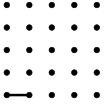
... and draw the rest of the square in by making sure that the sides are at right angles and of the same length - things that you know about squares!
That would give us:
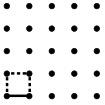
This would be the smallest square that we can make from drawing a line from the bottom left-hand corner to one of the other dots.
We can of course draw other starting lines, such as:
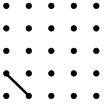
and another such as:
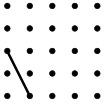
These would lead to squares that would be:
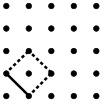
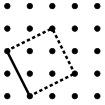
I wonder what size these squares are compared with the first smallest square?
Your challenge is to make more and more squares by using your starting side (roughly in the lower left-hand part) to other points marked in the 5 by 5 arrangement.
The investigation is about ways of finding out the areas of all these squares. You do not need any special knowledge but you may need lots of squared paper and a pair of scissors. You may be wanting to use a piece of cut-out card. I guess you'll need a chance to discuss this with friends.
When you've got all your areas sorted out you could continue this investigation by looking at the answers you've got and seeing if there are any special things about them ... I expect there are ... there usually are in these sorts of challenges.
Getting Started
How do you know that you have drawn a square?
How will you know that you have found all the possible squares from each point?
You might find it useful to print off this sheet of blank grids if you're not using the interactivity.
Student Solutions
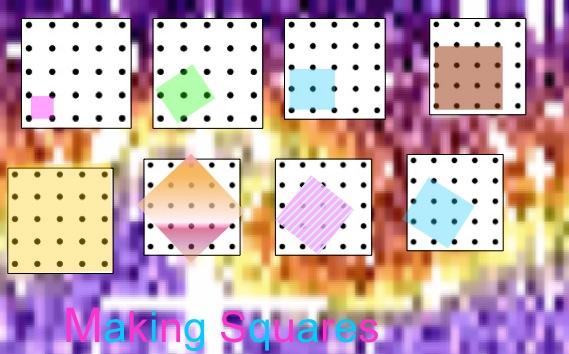
Tarusha and Sumona sent in this attractive set of solutions.
It's very picturesque but it shows that it can be hard to link squares to the grid, on a computer.
Teachers' Resources
Using NRICH Tasks Richly describes ways in which teachers and learners can work with NRICH tasks in the classroom.
Why do this problem?
Possible approach
Then indicate a different starting point on the grid (for example the second dot from the left in the bottom row) and ask pupils to work in pairs to find the squares that can be drawn from it. You may find that some children notice that 'tilted' squares can be drawn, or you may have to draw the class' attention to tilted squares by suggesting a second dot to be joined to the first dot. Again, take some time to share the squares they have found and talk about how you would find the areas of the tilted shapes.
You can then encourage learners to investigate other starting points on the grid, to draw the possible squares and find their areas. Make sure there are pairs of scissors available for pupils to use should they choose. In the plenary you can concentrate on good ways pupils have found to calculate the areas efficiently. This may have involved cutting out and laying pieces on a grid, or it could have involved annotating their squares in some way.
Key questions
Possible extension
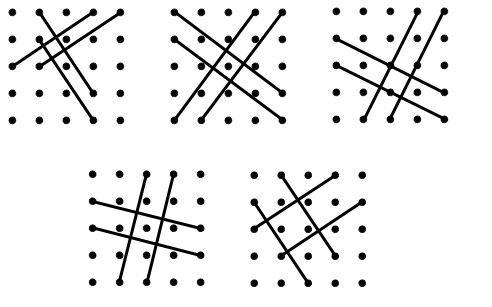
For more extension work
These pupils could act upon the extension activity that is outlined above but go further and calculate areas. Once they have done that, they could be challenged to find new squares that have an area that is between two values that they already have. They can then work towards making suggestions as to why, in certain circumstances, there are no new squares with 'in between' areas.