

Little Squares

 1 out of 3
Look at the squares in this problem. What does the next square look like? I draw a square with 81 little squares inside it. How long and how wide is my square?
Problem
Here are some squares:

This square is 1 little square long and 1 little square wide. It has 1 little square inside it.

This square is 2 little squares long and 2 little squares wide. It has 4 little squares inside it.
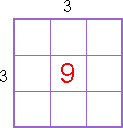
This square is 3 little squares long and 3 little squares wide. It has 9 little squares inside it.
Here is the next square:
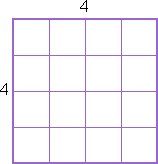
How many little squares are inside it?
What does the next square look like? How many little squares will there be inside it? I draw a square with 81 little squares inside it. How long and how wide is my square?
Getting Started
What numbers have you found?
What is special about those numbers?
What do you notice?
Could you find the difference between two numbers that follow each other?
Have you drawn any other squares?
How many little squares do you think there will be in the next big square?
Student Solutions
Ben working at home with his Dad sent us a solution to this problem:
Ben reckons for the four x four square, there should be 16 little squares inside. He says the next one should be five x five containing 25 little squares.
Alistair from Histon and Impington Infants School agreed with Ben's answers, and went a little further explaining how he worked out the last part:
I didn't know the answer to a square with 81 little squares, so I guessed 20, but 20 times 20 is 400 which is too big. I then thought of 10, but I knew that that would be 100 squares which is also too big, so I tried 9. 9 times 9 is 81, so the square would be 9 squares by 9 squares.
This is very well reasoned through Alistair.
Ryo who is 7 and goes to Moorfield Junior School adds:
I also know that 12 on each side will have 144 little squares. All these numbers are called square numbers because they always make squares.
Thank you to all three of you for sending in your contributions.
Teachers' Resources
Using NRICH Tasks Richly describes ways in which teachers and learners can work with NRICH tasks in the classroom.