
Tessellating Transformations

 2 out of 3
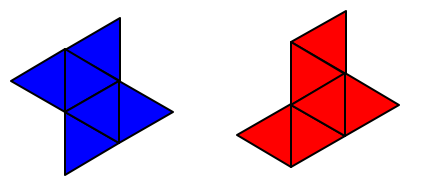
Can you find out how the 6-triangle shape is transformed in these tessellations? Will the tessellations go on for ever? Why or why not?
Problem
It is such fun to do some tessellating!
I've been using some Polydron (plastic shapes which click together) and making some rules before setting off:
Rule one - we will use six equilateral triangles for a shape and that'll be our tessellating shape.
Rule two - we can flip the shape over and turn it around but the basic shape - the way the triangles are connected - must remain the same.
Well, here's one I started with:
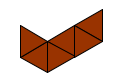
Then I tried to put a number of these together;
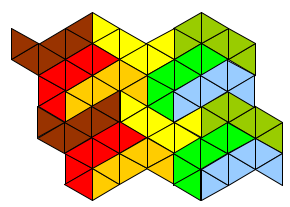
I had to flip the brown one over to get the red one, rotate it to get the blue one, and so on.
Having done this much of the tessellation, I could see that it could easily continue on for ever!
Can you find out or see why?
Then I tried another:
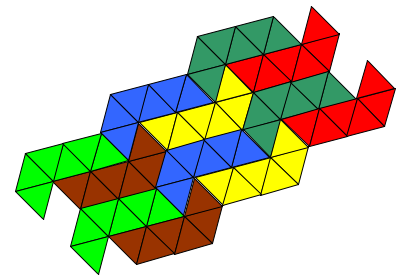
This came about by just turning the brown one around to get the greens and blue.
Do you think this one could go on and on? If so, why?
Now the third one I got was like this:
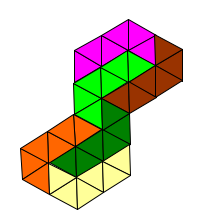
This I rather liked because it seemed to be complete and did not have anything sticking out.
I wonder if you can see what flips and turns I did with the pink one to get some of the others?
Would this one go on and on?
If so, how would you go about it?
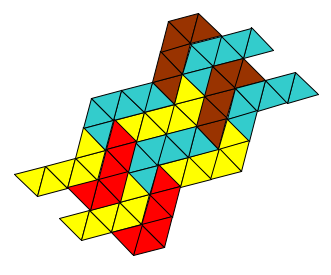
Well there's the last one I'm sharing.
What can you say about it?
Well I think it's your turn (or flip!!).
What ones can you make?
You could start with the 6 put together like mine - and maybe try to do one of those above.
OR
You could find other tessellating shapes with the same starting shape.
OR
You could design your own 6-triangle shape and start tessellating.
Getting Started
You will almost certainly find it helpful to do one or more of the following:
- Use Polydron (making many of the same shape, each shape - one colour);
- Cut out the shape you want to use from card;
- Use a computer program to make the shape in the first place (I used Word Draw and discovered that holding down 'Shift' when using rotate does the rotation in equal steps, which was very helpful!).
Student Solutions
We haven't heard from anyone who's tried this problem yet.
If you've thought about which of the tessellations in the problem go on for ever, do let us know. Perhaps you've investigated how they are made from the starting shape?
We would like to see some of the tessellations you produce - please do send us your images and don't worry that your solution is not "complete" - we'd like to hear about anything you have tried.
Teachers - you might like to send a summary of your children's work.
Teachers' Resources
Using NRICH Tasks Richly describes ways in which teachers and learners can work with NRICH tasks in the classroom.
Why do this problem?
Possible approach