

Overlapping Squares

 1 out of 3
Have a good look at these images. Can you describe what is happening? There are plenty more images like this on NRICH's Exploring Squares CD.
Problem
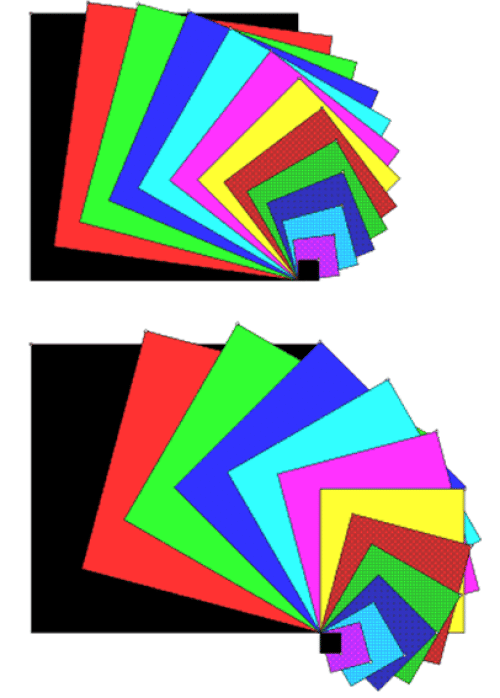
Describe what is happening in these pictures.
How many squares are there in each picture?
If the side of the smallest square is 1 unit, how many units is the side of the next square?
And the next?
What is the area of the smallest square?
What is the area of the next square? And the next?
The smallest square is one unit of area. How many more units are in the second square?
How many more units of area are in the third square than in the second square?
Look at the top picture. Start from the largest square and think of it as shrinking as it turns.
Through what angle has it turned when it has changed to the smallest square?
Is it the same in both pictures?
What is the angle of rotation as one square changes to the next?
Teachers' Resources
Using NRICH Tasks Richly describes ways in which teachers and learners can work with NRICH tasks in the classroom.
Possible approach
This image might be best displayed on an interactive whiteboard, or printed off on A3 paper for display. Alternatively, many classrooms now have access to data projectors so large images can be thrown onto a screen. The value of the use of the images with interactive whiteboards is the potential to be able to draw and add notation and ideas to the image as prompts for discussion, or as the result of pupils' observations. Some interactive whiteboards also have tools that enable angles or lines to be measured so that comparison is made easy (failing this a metre rule and a board protractor can be equally effective).
The intention is that pupils will discuss and share insights about what they see within the image, with the potential for them to go on to use it as a focus for investigative activities.
There is a visual dynamic in this image that can be experienced as the squares approaching or receding, or giving the impression of spiralling up or down. This image gives opportunities for pupils to estimate and conjecture, and even justify their hypotheses. They will be using knowledge of area and angles in an intriguing context, and at the same time, they will be developing their mathematical language.
Possible extension
You might wish to experiment with the following LOGO program:
TO SQ :N
REPEAT 4 [ FD :N RT 90] LT 20
SQ :N + 10