

Chippy's Journeys

 1 out of 3
Chippy the Robot goes on journeys. How far and in what direction must he travel to get back to his base?
Problem
Chippy the Robot was sent on a journey.
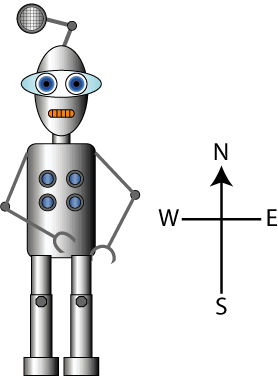
Chippy started from his base station and went $2$m (metres) N (North).
Then he turned and went $2$m E (East), $3$m N, then $3$m W (West) and $2$m S (South).
After that he went $2$m E, $3$m N and $3$m W again.
Then he went $5$m S and $4$m E.
Finally, he went $1$m S.
There he stopped.
How many metres altogether did Chippy travel on that journey?
How far and in what direction must Chippy travel to get back to his base station?
The next day Chippy went on another journey.
This time he started $3$ m (metres) West and $4$ m North of his base station. He went $6$ m E, $2$ m N, $4$ m W and $1$ m S. He then turned round and retraced his movements for $4$ m.
Where did he end up?
Can you find the shortest route to get him back to his base station?
How many metres did he have to go to get back?
Can you find him a route back which is exactly $12$ m?
How many different $12$ m routes can you find?
Getting Started
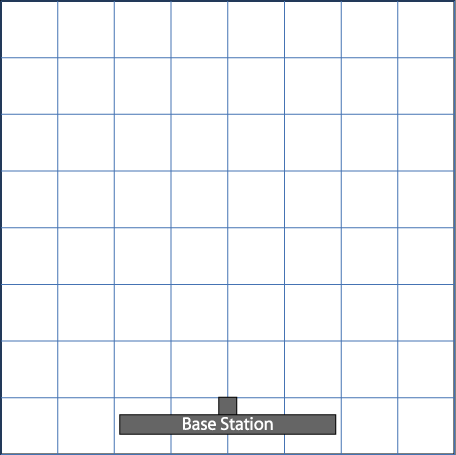
How about using squared paper to draw out Chippy's routes?
What will $1$ square on the paper stand for in metres?
Student Solutions
We received lots of correct answers to the first part of this problem but very few of you told us how you went about solving it. Some of you drew a diagram of Chippy's route, which was a very good way of tackling it. Rukmini from Hopscotch Nursery and Christy, sent particularly clear pictures. Here is Rukmini's:
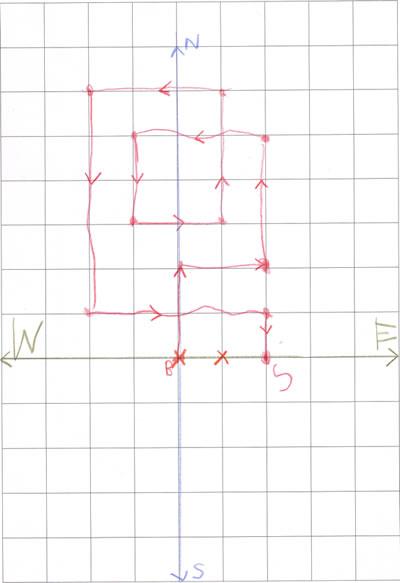
Rukmini says:
Tom who lives in New Zealand, solved the the first part of problem in a different, but equally as good way. Here is what Tom says:
| N | S | E | W | |
| 2 | 2 | 2 | 3 | |
| 3 | 5 | 2 | 3 | |
| 3 | 1 | 4 | ||
| Total | 8 | 8 | 8 | 6 |
Well done to you all for your well explained solutions.
Teachers' Resources
Using NRICH Tasks Richly describes ways in which teachers and learners can work with NRICH tasks in the classroom.
Why do this problem?
Possible approach
Key questions
Possible extension
Those who found this problem easy could make their own journeys for Chippy for other learners to draw out. Alternatively, they could try The Hare and the Tortoise, a problem about speed and distance.
Possible support
If at all possible suggest tackling this problem practically using a grid drawn on the ground. Otherwise use a counter on $2$ cm squared paper.