

Rabbits in the Pen

 2 out of 3
Using the statements, can you work out how many of each type of rabbit there are in these pens?
Problem
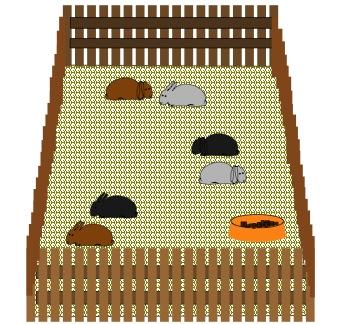
Here are $6$ different rabbits waiting to go to a home. They are in a pen in a pet shop. You'll see $2$ brown, $2$ black and $2$ grey. There is a floppy-eared one and an ordinary one of each colour.
Let's imagine that rabbits can only be one of these $6$ different kinds and there are no other kinds of rabbits. Then:
How many, and of what kind, will there be in a pen if all these statements are true?
- There are more brown than any other colour
- There are equal numbers of floppy browns and ordinary browns
- There are three which have floppy ears
- There are twice as many floppy browns as floppy whites
- There are three times as many blacks as whites
How many, and of what kind, will there be in the second shop if all these statements are true?
- There are the same number of blacks as browns
- There are twice as many floppy browns as ordinary browns
- There are the same number of floppy browns as floppy greys
- All but one are floppy
Getting Started
How about trying with one floppy brown first. How many of the other types of rabbits would this mean there are?
Does this work? If not, you could try with two floppy browns.
How will you record what you are trying?
You could use counters or blocks for the different kinds of rabbits. Or you could use symbols or simple pictures on paper.
Student Solutions
We had a very large number of solutions sent - many of them were particularly pleasing as they included really good explanations as to how you were thinking. This is something we do wish to encourage.
As well as individual solutions coming in there were quite a number from groups of children at Oxgangs, Hotwells, St. Joseph's and Gateway schools. Thank you to the staff who gave the pupils opportunities to send in solutions. Here is a solution that came from Amanda and Paula.
Solution to the first pen-
First we started with trial and error to find out how many brown floppies
there would be. Then we found out that one wouldn't work so we tried two.
So if there were two brown floppies then there has to be two brown
ordinaries too. Then we wrote that and charted down the rest of the
categories like this-
Brown flop: 2
Brown ordinary: 2
Black flop : ?
Black ordinary: ?
White flop: ?
White ordinary: ?
After that we tried to find out what the white and black were.. So we knew
that there are three times as many blacks as whites. So if we put one next
to the white flop then three next to the black ordinary like this-
Brown flop: 2
Brown ordinary: 2
Black flop: ?
Black ordinary: 3
White flop: 1
White ordinary: ?
And we knew that it couldn't be black flop because if it was then there
are three with floppy ears that wouldn't work. And then we put in zeros
next to the empty ones like this-
Brown flop: 2
Brown ordinary: 2
Black flop: 0
Black ordinary: 3
White flop: 1
White ordinary: 0
And then we checked it and it worked.
Solution to the second pen-
First we did trial and error to try and find out how many floppy browns
there are. Then we started with one and we knew that couldn't be right
because brown ordinary has to be half of brown flop. There can only be one
ordinary so brown flop definitely had to be two. We put zeros next to all
the ordinaries because there can only be one ordinary and that is brown. We
wrote it out like this-
Brown flop: 2
Brown ordinary: 1
Black flop; ?
Black ordinary: 0
Grey flop: ?
Grey ordinary: 0
Then to find out what black flop was we added up both the browns and it
equaled three. We did that because there is the same number as blacks as
browns. We added it in like this-
Brown flop: 2
Brown ordinary: 1
Black flop: 3
Black ordinary: 0
Grey flop: ?
Grey ordinary: 0
So now all we need to work out is grey flop. And we knew that there are
the same number as floppy browns as floppy greys. Floppy brown is two so
grey flop is also two.So we put it like this-
Brown flop: 2
Brown ordinary: 1
Black flop: 3
Black ordinary: 0
Grey flop: 2
Grey ordinary: 0
Then we checked it and we found out it all worked out.
Teachers' Resources
Using NRICH Tasks Richly describes ways in which teachers and learners can work with NRICH tasks in the classroom.
Why do this problem?
Possible approach
Key questions
Possible extension
Possible support
- There are twice as many floppy ears as ordinary ears
- There are the same number of grey floppy ears as brown floppy ears and as black floppy ears
- There are the same number of grey ordinary ears as brown ordinary ears and as black ordinary ears
- There are 9 rabbits altogether
The idea would be to encourage a trial and improvement approach, and for children to realise that the information is not necessarily useful in the order it is given!