

Six in a Circle

 2 out of 3
If there is a ring of six chairs and thirty children must either sit on a chair or stand behind one, how many children will be behind each chair?
Problem
A class of 30 children were numbered from 1 to 30. Here are some of the class:
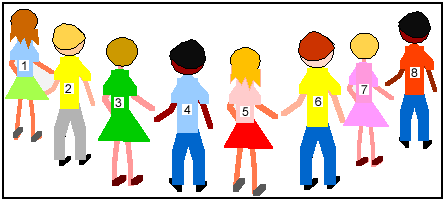
Their teacher set out a ring of 6 chairs.
Child number 1 sat on the first chair, child number 2 on the second chair, child number 3 on the third and so on going round the circle, up to child number 6. The teacher then asked child number 7 to stand behind child 1, child 8 to stand behind number 2 etc. They continued this pattern until all the children were either sitting on a chair, or standing behind one.
How many people were standing behind each chair?
Who was standing behind child number 3?
What would happen if there were only 4 chairs?
Getting Started
Perhaps finding a way to record this might be useful? How about using numbers $1$ to $30$ on bits of paper and arranging them?
Is there a link to factors and multiples which may help?
Student Solutions
We received two particularly good solutions to this problem. The first is from Helen and Daniela who go to Aldermaston C of E Primary School. They drew this table to help answer the questions:
| 1 | 2 | 3 | 4 | 5 | 6 |
| 7 | 8 | 9 | 10 | 11 | 12 |
| 13 | 14 | 15 | 16 | 17 | 18 |
| 19 | 20 | 21 | 22 | 23 | 24 |
| 25 | 26 | 27 | 28 | 29 | 30 |
They therefore concluded that:
There are $4$ children behind each chair.
Children $9, 15, 21, 27$ were standing behind chair $3$.
Here's the table they drew for only four chairs:
| 1 | 2 | 3 | 4 |
| 5 | 6 | 7 | 8 |
| 9 | 10 | 11 | 12 |
| 13 | 14 | 15 | 16 |
| 17 | 18 | 19 | 20 |
| 21 | 22 | 23 | 24 |
| 25 | 26 | 27 | 28 |
| 29 | 30 |
They comment that:
Seven children are behind $1$ and $2$. Six children are behind $3$ and $4$.
There can't be the same number behind each chair because $30$ doesn't go into $4$ but $30$ goes into $6$. (I think perhaps you mean that $4$ doesn't go into $30$, but $6$ does.)
The second was from Joe and Richard at St. Nicolas CE Junior School, Newbury who also drew a diagram to help them solve the problem:
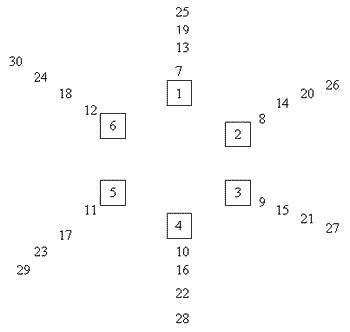
Joe and Richard say:
We started by drawing children round the circle like in our diagram above. We answered the questions next.
1) Four people were standing behind each chair.
2) Behind number $3$, there were $9, 15, 21, 27$.
We made another drawing but with $4$ chairs and put the children round the circle. In the end, we counted the children up. $1$ and $2$ had $7$ children behind each and $3$ and $4$ had $6$ children. Then we noticed that however many chairs there were, the numbers went up by the highest numbered chair. We tested this solution by using $2$ to $6$ chairs and it worked.
We also noticed that on the last chair, the numbers go up in its table. We tested this on numbers of chairs from $2$ to $6$ and it worked with every single one.
We noticed that because $6$ is a factor of $30$ and $4$ isn't, $4$ didn't have the same number of children around each chair and $6$ did. Then we noticed the only numbers of chairs that would have an equal number of children behind each chair were factors of $30$, which are $1, 2, 3 ,5, 6, 10, 15$ and $30$.
Helen and Pauline from Moorfield Junior School also drew a chart. I think this was a useful strategy. Well done to everyone who answered this correctly and gave good explanations.
Teachers' Resources
Using NRICH Tasks Richly describes ways in which teachers and learners can work with NRICH tasks in the classroom.
Why do this problem?
This problem is a useful one when children are being introduced to, or continuing work, on multiples (and factors). It could be illustrated practically with real chairs and children holding numbered cards.
Key questions
Possible extension
Learners could try with other numbers besides 6 and 4. If they find these problems straightforward they could try this problem about multiples and other sets of numbers.
Possible support
Many children will find it helpful to draw out the six chairs and use numbered counters (or numbered bits of paper) to find out what happens. Encourage quick recording before the bits of paper get blown away!