Quadratic Patterns
Surprising numerical patterns can be explained using algebra and diagrams...
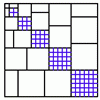
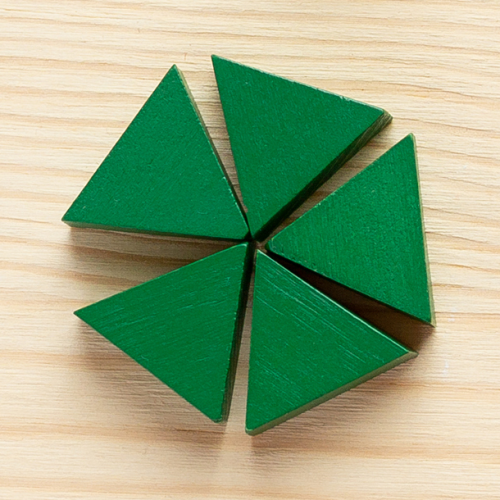
Can you see how this picture illustrates the formula for the sum of the first six cube numbers?
You are only given the three midpoints of the sides of a triangle. How can you construct the original triangle?
In this problem we are faced with an apparently easy area problem, but it has gone horribly wrong! What happened?
What is the largest number which, when divided into these five numbers in turn, leaves the same remainder each time?
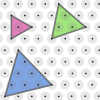
Can you find a general rule for finding the areas of equilateral triangles drawn on an isometric grid?
A mother wants to share some money by giving each child in turn a lump sum plus a fraction of the remainder. How can she do this to share the money out equally?
Many numbers can be expressed as the difference of two perfect squares. What do you notice about the numbers you CANNOT make?
Take any prime number greater than 3 , square it and subtract one. Working on the building blocks will help you to explain what is special about your results.
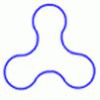
Each of the following shapes is made from arcs of a circle of radius r. What is the perimeter of a shape with 3, 4, 5 and n "nodes".