
1 to 8
Place the numbers 1 to 8 in the circles so that no consecutive numbers are joined by a line.

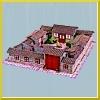
In a square in which the houses are evenly spaced, numbers 3 and 10 are opposite each other. What is the smallest and what is the largest possible number of houses in the square?
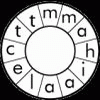
Investigate the different ways these aliens count in this challenge. You could start by thinking about how each of them would write our number 7.
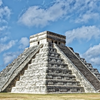
Imagine a pyramid which is built in square layers of small cubes. If we number the cubes from the top, starting with 1, can you picture which cubes are directly below this first cube?
Take a look at the video of this trick. Can you perform it yourself? Why is this maths and not magic?
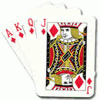
A magician took a suit of thirteen cards and held them in his hand face down. Every card he revealed had the same value as the one he had just finished spelling. How did this work?