Expanding and factorising quadratics
-
-
problemNovemberish
a) A four digit number (in base 10) aabb is a perfect square. Discuss ways of systematically finding this number. (b) Prove that 11^{10}-1 is divisible by 100. -
problemCommon Divisor
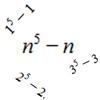
Find the largest integer which divides every member of the following sequence: 1^5-1, 2^5-2, 3^5-3, ... n^5-n.
-
problemMultiplication Magic
Given any 3 digit number you can use the given digits and name another number which is divisible by 37 (e.g. given 628 you say 628371 is divisible by 37 because you know that 6+3 = 2+7 = 8+1 = 9). The question asks you to explain the trick.
-
problemTwo Cubes
Two cubes have a combined volume equal to the total of the lengths of their edges. How big are the cubes?
-
problemNever Prime
If a two digit number has its digits reversed and the smaller of the two numbers is subtracted from the larger, prove the difference can never be prime.
-
problemNumber Rules - OK
Can you produce convincing arguments that a selection of statements about numbers are true?
-
problemComposite Notions
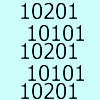
A composite number is one that is neither prime nor 1. Show that 10201 is composite in any base.
-
problemLeftovers
Weekly Problem 26 - 2008
If $n$ is a positive integer, how many different values for the remainder are obtained when $n^2$ is divided by $n+4$? -
problemGeometric Parabola
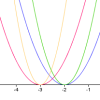
Explore what happens when you draw graphs of quadratic equations with coefficients based on a geometric sequence.