What Does Random Look Like?
Engage in a little mathematical detective work to see if you can spot the fakes.

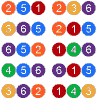
Seven balls are shaken. You win if the two blue balls end up touching. What is the probability of winning?
Six balls are shaken. You win if at least one red ball ends in a corner. What is the probability of winning?
Can you decide whether these short statistical statements are always, sometimes or never true?
Imagine a room full of people who keep flipping coins until they get a tail. Will anyone get six heads in a row?
When two closely matched teams play each other, what is the most likely result?
If everyone in your class picked a number from 1 to 225, do you think any two people would pick the same number?
Can you work out the probability of winning the Mathsland National Lottery?
In this follow-up to the problem Odds and Evens, we invite you to analyse a probability situation in order to find the general solution for a fair game.
Can you work out which spinners were used to generate the frequency charts?