
Two Cubes
Two cubes have a combined volume equal to the total of the lengths of their edges. How big are the cubes?
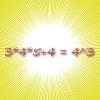

Janine noticed, while studying some cube numbers, that if you take three consecutive whole numbers and multiply them together and then add the middle number of the three, you get the middle number. Does this always work? Can you prove or disprove this conjecture?
Find the polynomial p(x) with integer coefficients such that one solution of the equation p(x)=0 is $1+\sqrt 2+\sqrt 3$.
Observe symmetries and engage the power of substitution to solve complicated equations.
Find the relationship between the locations of points of inflection, maxima and minima of functions.
If x, y and z are real numbers such that: x + y + z = 5 and xy + yz + zx = 3. What is the largest value that any of the numbers can have?
What have Fibonacci numbers to do with solutions of the quadratic equation x^2 - x - 1 = 0 ?
A sequence of polynomials starts 0, 1 and each poly is given by combining the two polys in the sequence just before it. Investigate and prove results about the roots of the polys.
Given a set of points (x,y) with distinct x values, find a polynomial that goes through all of them, then prove some results about the existence and uniqueness of these polynomials.