
Seeing Parallelograms
Players take it in turns to choose a dot on the grid. The winner is the first to have four dots that can be joined to form a parallelogram.
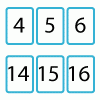
Here is an interesting property about two sets of digits. Can you work out what the digits might be?
Can you find the missing number(s)? The square is the average (mean) of the numbers surrounding it.
Can you find combinations of strips of paper which equal the length of the black strip? If the length of the black is 1, how could you write the sum of the strips?
Roll two red dice and a green dice. Add the two numbers on the red dice and take away the number on the green. What are all the different possible answers?
What happens if you join every second point on this circle? How about every third point? Try with different steps and see if you can predict what will happen.
Let's say you can only use two different lengths - 2 units and 4 units. Using just these 2 lengths as the edges how many different cuboids can you make?
Can you go through this maze so that the numbers you pass add to exactly 100?
In a square in which the houses are evenly spaced, numbers 3 and 10 are opposite each other. What is the smallest and what is the largest possible number of houses in the square?