
Calculating With Cosines
If I tell you two sides of a right-angled triangle, you can easily work out the third. But what if the angle between the two sides is not a right angle?
Which numbers cannot be written as the sum of two or more consecutive numbers?
$40$ can be written as $7^2 - 3^2.$ Which other numbers can be written as the difference of squares of odd numbers?
Can you prove that triangles are right-angled when $a^2+b^2=c^2$?
Try to solve this very difficult problem and then study our two suggested solutions. How would you use your knowledge to try to solve variants on the original problem?
Can you correctly order the steps in the proof of the formula for the sum of the first n terms in a geometric sequence?
Try this interactivity to familiarise yourself with the proof that the square root of 2 is irrational. Sort the steps of the proof into the correct order.
Put the steps of this proof in order to find the formula for the sum of an arithmetic sequence
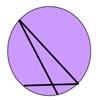
A and B are two fixed points on a circle and RS is a variable diamater. What is the locus of the intersection P of AR and BS?
Three equilateral triangles ABC, AYX and XZB are drawn with the point X a moveable point on AB. The points P, Q and R are the centres of the three triangles. What can you say about triangle PQR?