
Explaining, convincing and proving

  • Summats Clear
    problem

    Summats Clear

    Age
    16 to 18
    Challenge level
    1 out of 3

    Find the sum, f(n), of the first n terms of the sequence: 0, 1, 1, 2, 2, 3, 3........p, p, p +1, p + 1,..... Prove that f(a + b) - f(a - b) = ab.

  • Stonehenge
    problem

    Stonehenge

    Age
    16 to 18
    Challenge level
    1 out of 3

    Explain why, when moving heavy objects on rollers, the object moves twice as fast as the rollers. Try a similar experiment yourself.


  • Code to Zero
    problem

    Code to Zero

    Age
    16 to 18
    Challenge level
    1 out of 3

    Find all 3 digit numbers such that by adding the first digit, the square of the second and the cube of the third you get the original number, for example 1 + 3^2 + 5^3 = 135.

  • Without Calculus
    problem

    Without Calculus

    Age
    16 to 18
    Challenge level
    1 out of 3

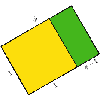
    Given that u>0 and v>0 find the smallest possible value of 1/u + 1/v given that u + v = 5 by different methods.

  • Pythagorean Golden Means
    problem

    Pythagorean Golden Means

    Age
    16 to 18
    Challenge level
    1 out of 3

    Show that the arithmetic mean, geometric mean and harmonic mean of a and b can be the lengths of the sides of a right-angles triangle if and only if a = bx^3, where x is the Golden Ratio.

  • Three Ways
    problem

    Three Ways

    Age
    16 to 18
    Challenge level
    1 out of 3

    If x + y = -1 find the largest value of xy by coordinate geometry, by calculus and by algebra.

  • Big, Bigger, Biggest
    problem

    Big, Bigger, Biggest

    Age
    16 to 18
    Challenge level
    1 out of 3

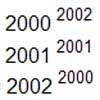
    Which is the biggest and which the smallest of $2000^{2002}, 2001^{2001} \text{and } 2002^{2000}$?

  • Pair Squares
    problem

    Pair Squares

    Age
    16 to 18
    Challenge level
    1 out of 3

    The sum of any two of the numbers 2, 34 and 47 is a perfect square. Choose three square numbers and find sets of three integers with this property. Generalise to four integers.

  • Diverging
    problem

    Diverging

    Age
    16 to 18
    Challenge level
    1 out of 3

    Show that for natural numbers x and y if x/y > 1 then x/y>(x+1)/(y+1}>1. Hence prove that the product for i=1 to n of [(2i)/(2i-1)] tends to infinity as n tends to infinity.

  • Tetra Inequalities
    problem

    Tetra Inequalities

    Age
    16 to 18
    Challenge level
    1 out of 3

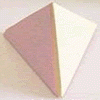
    Can you prove that in every tetrahedron there is a vertex where the three edges meeting at that vertex have lengths which could be the sides of a triangle?